
Unit economics calculator: LTV, CAC and payback
LTV, LTV to CAC, and CAC payback from one set of inputs, per our SaaS metrics guide.
The short answer
This unit economics calculator turns price, gross margin, monthly churn, and CAC into contribution margin, LTV, LTV to CAC, and payback. On the example, fictional Sample Wick has an LTV to CAC of 2.00 and a CAC payback of 10.00 months. David Skok's line for the best SaaS businesses is higher than 3, and 2.00 is under it. Those inputs are example data, not a live business.
How the unit economics calculator works
Type a monthly price, a gross margin percent, a monthly churn percent, and CAC. The form prints LTV to CAC as the large figure, then LTV, monthly contribution margin, and CAC payback.
Contribution margin is the price times gross margin. That is the gross profit one customer leaves in a month. LTV is that profit divided by monthly churn. LTV to CAC is LTV divided by CAC. Payback is CAC divided by the monthly contribution margin. Type 80 for 80%, not 0.80.
The same LTV division, on a different example, is the customer lifetime value calculator. The channel spend behind a CAC is the CAC calculator. A different month count divides acquisition spend by new MRR times gross margin. That reading is the CAC payback calculator. What belongs in the margin, hosting and payment fees included, is SaaS gross margin.
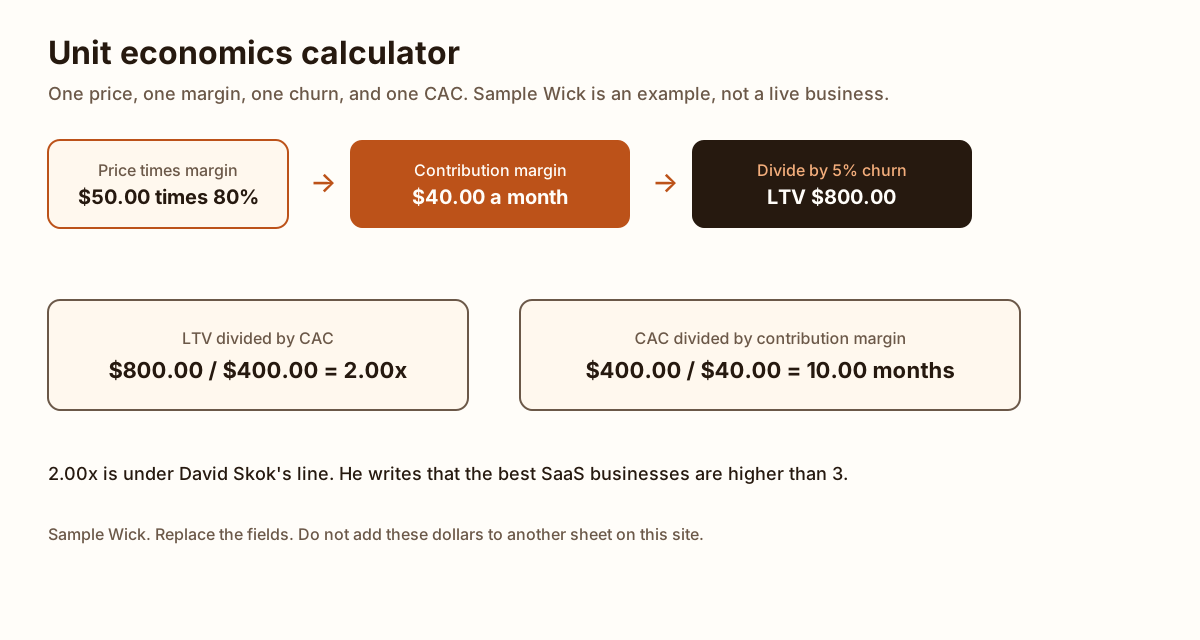
Unit economics example
The fields open on EXAMPLE inputs for fictional Sample Wick. Nothing here was measured from a live business. Do not add Sample Wick to Cedar Desk, Harbor Notes, Pebble Desk, Rowan Desk, or Sample Meter. The table is the arithmetic.
| Step | Arithmetic | Result |
|---|---|---|
| Monthly price | Example input | $50.00 |
| Gross margin | Example input | 80% |
| Contribution margin | $50.00 × 80% | $40.00 |
| Monthly churn | Example input | 5% |
| LTV | $40.00 / 5% | $800.00 |
| CAC | Example input | $400.00 |
| LTV to CAC | $800.00 / $400.00 | 2.00 |
| CAC payback | $400.00 / $40.00 | 10.00 months |
The same rows are in the sheet linked below.
What is a good LTV to CAC ratio
Pick higher than 3 if you are using David Skok's line for the best SaaS businesses. Pick 3x as a minimum if you are using Airtree's line for a mature SaaS company. Exactly 3 meets Airtree's minimum and is not higher than 3 on Skok's line. The pass line on this form is Skok's higher-than-3. The 2.00 example fails it.
David Skok, SaaS Metrics 2.0, checked November 20, 2026, says the best SaaS businesses have an LTV to CAC ratio higher than 3, sometimes as high as 7 or 8. He also writes that many healthy SaaS businesses do not meet the guidelines in the early days, and that many of the best recover CAC in 5 to 7 months. A May 2016 note on that page says a later article replaces the LTV formulas linked from it. The higher-than-3 line is still on the page. This form does not use his discounted formula. Sample Wick's 10.00 months are not inside that 5 to 7.
Airtree Ventures, last reviewed October 23, 2024 and checked November 20, 2026, looks for a minimum LTV to CAC of 3x for mature SaaS businesses. The same page says Airtree usually will not look at the ratio until Series B or C. Their LTV is a discounted cash flow: lifetime is 1 divided by annual churn, with a cost of capital in the formula. This form is the undiscounted monthly division.
Stripe's payback page, updated September 10, 2024 and checked November 20, 2026, calls 3:1 or higher a generally accepted LTV to CAC benchmark, and it defines that lifetime value as revenue. The same page says a SaaS payback of 12 months or less is typically healthy, and that high-performing SaaS businesses often land at five to seven months. Sample Wick's LTV is gross profit, so Stripe's 3:1 is not this form's test. The 10.00 months are inside Stripe's 12 and outside the five to seven.
Download the sheet
The Unit economics template (CSV) is the Sample Wick table: the inputs, the four results, and a note that the row is example data. Replace the inputs. Do not add them on top of a live customer.
What we tested
The Sample Wick rows were checked as arithmetic on November 20, 2026. Each result in the table is the formula in that row. David Skok's SaaS Metrics 2.0 page, Airtree's CAC payback and LTV to CAC page, and Stripe's CAC payback page were opened the same day. Sample Wick is fictional. No customer file was measured for it.
The other calculators are on the tools page. The rest of the money posts are on Money and ops.
FAQ
What is the unit economics formula?
Monthly contribution margin is price times gross margin. LTV is that margin divided by monthly churn. LTV to CAC is LTV divided by CAC. CAC payback is CAC divided by the monthly contribution margin. On the Sample Wick example, $50.00 times 80% is $40.00, $40.00 divided by 5% is $800.00, $800.00 divided by $400.00 is 2.00, and $400.00 divided by $40.00 is 10.00 months.
What is a good LTV to CAC ratio?
David Skok, in SaaS Metrics 2.0, checked November 20, 2026, says the best SaaS businesses have an LTV to CAC ratio higher than 3, sometimes as high as 7 or 8. Airtree Ventures, last reviewed October 23, 2024 and checked November 20, 2026, looks for a minimum of 3x for mature SaaS businesses, and usually will not look at the ratio until Series B or C. The Sample Wick example is 2.00, which is under both. Stripe’s payback page, updated September 10, 2024, calls 3:1 or higher a generally accepted benchmark and defines that LTV as revenue, not gross profit. This form’s LTV is gross profit, so Stripe’s 3:1 is a different test.
What is a unit economics model?
A unit economics model is the same four results from one customer: contribution margin, LTV, LTV to CAC, and CAC payback. The sheet download is that model for Sample Wick, with a blank you can replace. It is not a full company forecast. Burn and runway are a different question.
What is CAC payback in this calculator?
Months of contribution margin it takes to cover CAC. Stripe’s payback page, updated September 10, 2024 and checked November 20, 2026, divides CAC by monthly profit per customer. On Sample Wick that is $400.00 divided by $40.00, which is 10.00 months. A different month count divides acquisition spend by new MRR times gross margin. That reading is the CAC payback calculator, on a different sample.