
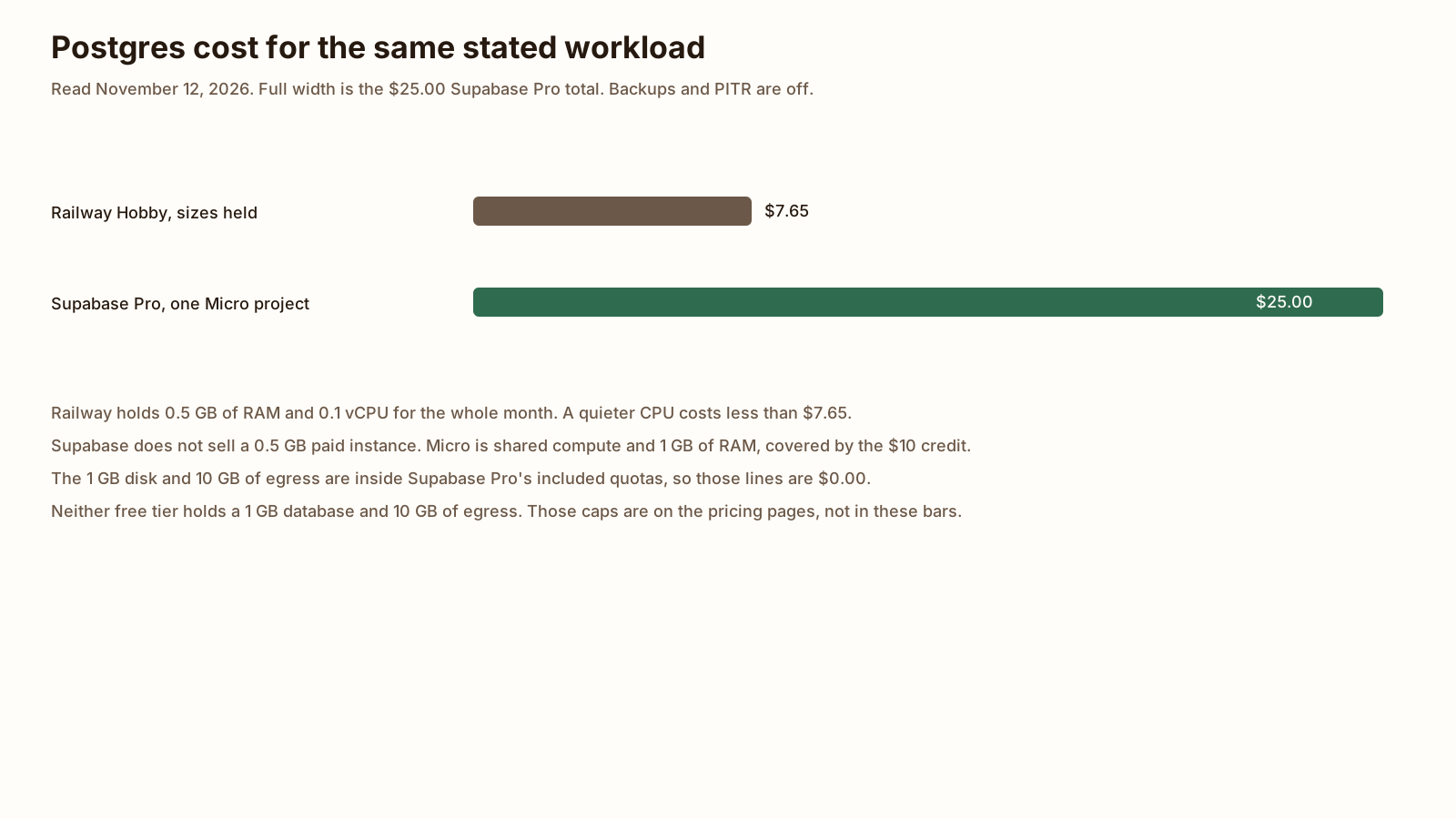
The stated Postgres workload is $7.65 on Railway Hobby if those sizes are held all month. Supabase Pro is $25.00 for one Micro project, and the disk and egress sit inside the quotas.
On this page
The short answer
Pick Railway when you want Postgres and you will add auth, files, and an API yourself. Held all month, that workload is $7.65 on Hobby. Pick Supabase when you want those products in the project: Pro is $25.00, the smallest paid instance is Micro at 1 GB of RAM, and this 1 GB database and 10 GB of egress sit inside the included quotas.
Railway vs Supabase, the railway supabase search, is a Postgres bill with a product choice stuck to it. Railway meters the database you run. Supabase sells a project that already contains Postgres, Auth, Storage, Realtime, and an API. If the other backend is Firebase, the bill at 1,000, 10,000, and 50,000 users is in Supabase vs Firebase. If the database is documents on Atlas or Firestore, one fixed workload is priced in MongoDB vs Firebase.
What we tested
Checked
The prices below are the vendor pages read on November 12, 2026. The workload is one Postgres database with 1 GB of disk, one always-on instance holding 0.5 GB of RAM and 0.1 vCPU, and 10 GB of egress. No account was opened, no database was deployed, and no invoice was paid. Where a page does not print a price for a line, the cell says the line is missing.
What each one is
Railway charges for the CPU, memory, and disk a service holds, per second, plus egress per GB. Hobby is $5 a month, including $5 of usage. Postgres on Railway is a template, not a separate database SKU. The Postgres page, read November 12, 2026, says the service is a single node Railway maintains, deployed from Railway’s SSL-enabled image on the official Postgres image. It exposes DATABASE_URL and the usual PGHOST, PGPORT, PGUSER, PGPASSWORD, and PGDATABASE variables. It is private by default. Public access is a TCP proxy, and that page says you are billed for network egress when you use the proxy.
Supabase sells a project that already contains Postgres, Auth, Storage, Realtime, and Edge Functions. The pricing page says unused products cost nothing, and that API requests are unlimited on every plan, Free included. A project can be used as a database only. The same page says a single database-only project on Micro costs $25 a month before usage past the included quotas. Plans in this comparison are Free and Pro. Team starts at $599 a month and is a different purchase.
The Railway rates on this page are the same monthly constants as Heroku alternatives, which read the Railway pricing page on the same day: $10 per GB of memory, $20 per vCPU, $0.15 per GB of volume, and $0.05 per GB of egress. That page’s app is a web process, Postgres, and a daily job, with egress at zero. This page is the database workload, with 10 GB of egress. A web service plus Postgres, also with egress at zero, is Railway vs Render.
If the database should suspend between queries, the free caps and the first paid month are in Neon vs Supabase. If the other backend is documents and TypeScript functions, the comparison is Convex vs Supabase. A Next.js process on Railway, with this Supabase bill left out, is Vercel vs Railway. The same Next.js app on Vercel or Netlify, with the free caps and a TTFB check, is Vercel vs Netlify.
Postgres pricing side by side
Every number in the table is from the Railway pricing page, the Railway plans page, or the Supabase pricing page, all read on November 12, 2026. The plans page prints the same monthly resource prices as the pricing page, with per-minute rates beside them. This table uses the monthly constants.
The two Railway pages agree on what a bill over the included credit costs, in different words. The pricing page says usage of $5 or less is not charged extra, and usage past $5 is charged as total usage. The plans page’s example is usage of $3 bills $5, and usage of $7 bills $7, which is the $5 subscription plus $2 over the credit. $5 plus $2 is $7. This post follows that result: past $5, the Hobby bill equals usage.
Supabase Pro is charged up front. The $10 compute credit covers one Micro instance. A second project pays its own compute. Spend caps are on by default on Pro.
| Line | Railway | Supabase |
|---|---|---|
| Plan fee | Hobby, $5 a month | Pro, from $25 a month, charged up front. Free is $0 |
| Included usage | $5 of usage on Hobby. $1 a month on Free. Trial is $5 once, for 30 days | Pro and Team include $10 a month of compute credits, which covers one Micro instance |
| Compute, RAM, vCPU | Memory $10 per GB-month. CPU $20 per vCPU-month. Per-second rates on the pricing page: $0.00000386 per GB and $0.00000772 per vCPU | Free: shared CPU, 500 MB RAM. Pro Micro: $10, shared compute, 1 GB RAM, 60 direct connections, 200 through the pooler. No 0.5 GB paid size is listed |
| Database storage | Volume, $0.15 per GB-month. Hobby volume cap is 5 GB | Free: 500 MB database size. Pro: 8 GB disk included, then $0.125 per GB |
| Egress | $0.05 per GB. The pricing table does not list included gigabytes | Free: 5 GB, plus 5 GB cached egress. Pro: 250 GB, then $0.09 per GB. Cached egress is 250 GB, then $0.03 per GB |
| Backups | Optional volume backups. Incremental size only, at the volume rate of $0.15 per GB-month. Daily kept 6 days, weekly 27 days, monthly 89 days | Free: automatic backups are not included. Pro: daily backups kept 7 days |
| PITR | No separate fee. Bucket storage at $0.015 per GB-month, plus service egress at $0.05 per GB for the uploads. The restore window is roughly 4 weeks | Pro add-on, $100 per month per 7 days of retention. The backups page prints $0.137 an hour and about $100 a month for 7 days |
| Free limits and pausing | Free: $1 of credit, max 1 vCPU and 0.5 GB per service, volume cap 500 MB on the pricing page and 0.5 GB on the plans page. A pause timer is not listed on either page | Free: 2 active projects, 500 MB database size, 5 GB egress. Free projects are paused after 1 week of inactivity. Paid projects are not paused |
Railway Postgres high availability, backups, and connection pooling are separate steps on the Postgres page. They are not included in the Hobby meter by default. Supabase’s backups page says Free projects should export with the CLI db dump command. Pro projects get the daily backups without a second line.
One worked month
One set of assumptions covers both bills.
The database stays on for the whole month. Disk is 1 GB. Memory is held at 0.5 GB. CPU is held at 0.1 vCPU, the small Postgres CPU used on the Heroku alternatives page. Railway does not sell that box. Egress is 10 GB of service egress, at the $0.05 rate, with no included gigabytes subtracted. No high availability. No second replica. No tax. Backups and point-in-time recovery are off, so neither bill contains an archive size. The Hobby fee is not waived. The plans page says Railway waives that fee for a small set of builders, picked automatically, and that asking for the waiver does nothing. This total does not assume a waiver.
Supabase does not sell a 0.5 GB paid instance. The paid bill uses Micro, 1 GB of RAM, because that is the smallest paid compute. The $10 price is covered by the $10 credit. The 1 GB database is treated as disk inside the 8 GB included on Pro, so the storage overage is $0.00. The pricing page prices disk on Pro, not a separate database-size line. If WAL pushed the disk past 8 GB, the page would charge $0.125 per GB. This bill does not add a WAL figure, because the pages do not give one for a 1 GB database. The 10 GB is uncached egress, inside the 250 GB included, so that overage is $0.00. Cached egress is a separate quota and is not used here.
| Line | Arithmetic | Amount |
|---|---|---|
| Railway memory | 0.5 times $10 | $5.00 |
| Railway CPU | 0.1 times $20 | $2.00 |
| Railway volume | 1 times $0.15 | $0.15 |
| Railway egress | 10 times $0.05 | $0.50 |
| Railway usage | 5.00 + 2.00 + 0.15 + 0.50 | $7.65 |
| Railway Hobby bill | $7.65 is above the $5 credit, so the bill equals the usage | $7.65 |
| Supabase Pro | Plan fee, charged up front | $25.00 |
| Supabase compute | Micro is $10, and the $10 credit covers that one instance | $0.00 |
| Supabase disk | 1 GB is inside 8 GB included | $0.00 |
| Supabase egress | 10 GB is inside 250 GB included | $0.00 |
| Supabase total | 25.00 + 0.00 + 0.00 + 0.00 | $25.00 |
| Railway backups | Incremental size for this 1 GB volume is not stated | Not in this bill |
| Railway PITR | Archive size for this database is not stated. There is no separate PITR fee | Not in this bill |
| Supabase PITR | Add-on is $100 per 7 days. This bill leaves it off | Not in this bill |
Check the Hobby line against the plans-page rule. $7.65 minus $5 is $2.65, and $5 plus $2.65 is $7.65. That is the “usage of $7 bills $7” case, not the “usage of $3 bills $5” case.
Neither free tier holds this shape. Railway Free caps a volume at 500 MB on the pricing page and at 0.5 GB on the plans page. A 1 GB volume does not fit. Memory of 0.5 GB held all month is $5.00 before CPU, disk, and egress, and Free includes $1. Supabase Free lists 500 MB of RAM, which is this workload’s 0.5 GB if a gigabyte is 1,000 megabytes. The database size cap is still 500 MB, and egress is still 5 GB, so the 1 GB database and the 10 GB of egress do not fit. Free projects also pause after a week of low activity. Paid Supabase projects do not.
-
$7.65
Railway Hobby, those sizes held all month
-
$25.00
Supabase Pro, one Micro project, inside the quotas
-
$5.00
Railway Hobby minimum, when usage is $5 or less
-
$0.00
Neither free tier holds 1 GB of disk and 10 GB of egress
A quieter Railway CPU costs less than $7.65. This page does not print that quieter total, because the defined hold is 0.1 vCPU. The $25.00 does not fall when the Supabase project is idle. Pro is charged up front, and paid projects are not paused.
What Supabase adds beyond Postgres
The split is the products, not a second copy of the $7.65. Supabase’s pricing page includes Auth, Storage, Realtime, and Edge Functions in every project, and unused products cost nothing. The Data REST API page, read November 12, 2026, says Supabase auto-generates a REST API from the database schema with PostgREST. The page puts that API at a project URL ending in /rest/v1/. Railway’s Postgres template gives you a connection string. It does not give you that API, Auth, file storage, Realtime, or Edge Functions.
| Piece | Supabase | Railway Postgres |
|---|---|---|
| Postgres | Included. Free is 500 MB of database size. Pro is 8 GB of disk, then $0.125 per GB | A template service plus a volume at $0.15 per GB-month |
| Auth | Included. 50,000 MAU on Free. 100,000 on Pro, then $0.00325 | Not in the Postgres template. You add it |
| File storage | 1 GB on Free. 100 GB on Pro, then $0.0213 per GB. Max upload 50 MB on Free and 500 GB on Pro | Not in the Postgres template. A Railway bucket is $0.015 per GB-month, which is object storage, not Supabase Storage |
| Realtime | Included. 200 concurrent peak connections and 2 million messages on Free. Pro is 500 connections, then $10 per 1,000, and 5 million messages, then $2.50 per million | Not in the Postgres template |
| Edge Functions | 500,000 invocations on Free. 2 million on Pro, then $2 per million | Not in the Postgres template |
| Auto API | PostgREST, generated from the schema. API requests are unlimited on every plan | Not in the Postgres template. The page gives you DATABASE_URL |
| Daily backups | Not included on Free. Included on Pro, kept 7 days. Storage files are not inside the database backup | Optional. Incremental size at $0.15 per GB-month. A 1 GB volume’s incremental size is not stated, so it is not in the $7.65 |
Point-in-time recovery is the add-on on both sides, and it is off in the worked month. Supabase’s pricing page lists it at $100 a month per 7 days of retention. The backups page says enabling PITR replaces the daily backups, and that the worst-case recovery point is two minutes. Railway’s PITR page says there is no separate fee. You pay bucket storage at $0.015 per GB-month for the compressed archive, and service egress at $0.05 per GB when WAL and base backups upload. The page says the last 4 full backups are retained, which is roughly 4 weeks. It does not print a gigabyte figure for a 1 GB database, so this page does not turn “a few GB a day” into a dollar line.
Can you run Supabase on Railway?
Yes. That path is self-hosting, and it is a different bill from the $7.65 and the $25.00.
Railway’s Supabase template page, read November 12, 2026, says the template deploys 10 services and 1 bucket. It does not name the services, and it does not print a CPU, a memory size, or a price. There is no monthly total to put next to $7.65.
A second template on Railway, Deploy Supabase, is by onepush. The page says it runs nine Docker services: Postgres, GoTrue auth, PostgREST, Realtime, Storage, Edge Functions, Studio, postgres-meta, and an Envoy gateway. Postgres and Storage are the stateful parts, each with a volume. The page states about $20 to $40 a month for nine small services at light use. It does not list the CPU, memory, or disk behind that range, so this post does not use the range as a total. The same page says Supavisor and Logflare are not included, and that managed backups, branching, and the org UI are cloud features you do not get from the template.
Supabase’s pricing page says you can self-host with the Docker setup or the Supabase CLI, and that the software is free. The Railway bill is still the resources those containers hold. You still turn on backups yourself. The $25.00 Pro plan is the managed project, with the daily backups included and the pause turned off. The template is the open-source stack on your own meter.
Which to pick
- You want Postgres, you will add auth, files, and an API yourself, and you can watch the CPU: Railway Hobby. $7.65 at the sizes in the table. A quieter CPU costs less. The 1 GB volume fits on Hobby, whose cap is 5 GB, and does not fit on Free.
- You want Auth, file storage, Realtime, Edge Functions, and a REST API generated from the schema, and this disk and egress fit the quotas: Supabase Pro. $25.00 for one Micro project. The instance is 1 GB of RAM, not 0.5 GB, because that is the smallest paid size. The plan does not pause.
- You are inside 500 MB of database size, 5 GB of egress, 1 GB of files, and 50,000 monthly active users, and a pause after a quiet week is acceptable: Supabase Free. This page’s 1 GB database and 10 GB of egress do not fit.
- You want the database to suspend between queries instead of either of these bills: Neon. The free caps and the Launch price are in Neon vs Supabase.
- You want a fixed instance price for a web service plus Postgres, with egress left at zero: Railway vs Render.
- You want the Supabase products on Railway: the template. The pages read today do not publish a metered total for those services. Do not treat the $7.65 row as the cost of the nine-service stack.
The $7.65 and the $25.00 are the decision on this page. They leave out tax, a waived Hobby fee, backup bytes, and any CPU the Railway service holds beyond 0.1 vCPU. Run the database for a week and read the usage screen before you treat $7.65 as the invoice.
Supabase vs Firebase: the bill at 1k, 10k, 50k The monthly bill at 1,000, 10,000, and 50,000 users, when the other backend is Firebase rather than a Railway volume. Blog Neon vs Supabase, free tier and the first paid month Hosted Postgres that can suspend, against the same Supabase project, on a different workload. Blog Railway vs Render for a small app One always-on web service and 1 GB of Postgres, with egress left at zero. A different shape from the $7.65 row. BlogFAQ
Can you deploy Supabase on Railway?
Yes. Railway’s template page at railway.com/new/template/supabase, read November 12, 2026, deploys 10 services and 1 bucket and does not print a price or a CPU size. A second template on Railway, by onepush, names nine services: Postgres, GoTrue auth, PostgREST, Realtime, Storage, Edge Functions, Studio, postgres-meta, and an Envoy gateway. That page states about $20 to $40 a month for light use and does not list the CPU, memory, or disk behind the range, so the range is not the $7.65 bill on this page.
Is Railway Postgres cheaper than Supabase?
For the workload on this page, yes. Railway Hobby is $7.65 if 0.5 GB of RAM, 0.1 vCPU, a 1 GB volume, and 10 GB of egress are held all month. Supabase Pro is $25.00 for one Micro project, and the 1 GB database and 10 GB of egress sit inside the included quotas. Supabase’s $25.00 includes Auth, Storage, Realtime, Edge Functions, and the auto API. Railway’s $7.65 is the database meter only. A quieter CPU is less than $7.65. These are readings of the price pages, not invoices.
What are the Railway Postgres alternatives?
Supabase, priced on this page, when you want Auth and the other products in the project. Neon, when the database should suspend between queries, in Neon vs Supabase. Render, which sells Postgres as a compute plan plus storage, in Railway vs Render. That Render page prices a web service plus 1 GB of Postgres with egress left at zero, not this 10 GB of egress.
Should you use Supabase and Railway together?
You can. Supabase can be the database and the API, and Railway can run the web process. This page does not price that pair, because the workload is the database only. A Next.js process priced against Railway, with the Supabase bill left out, is Vercel vs Railway. If Postgres, Auth, and Storage all sit on Railway, that is the self-hosted template, not the $25.00 Pro plan.
Sources
- Railway pricing Checked
- Pricing plans (Railway) Checked
- PostgreSQL (Railway) Checked
- Volume backups (Railway) Checked
- Point-in-time recovery (Railway) Checked
- Storage buckets billing (Railway) Checked
- Supabase template (Railway) Checked
- Deploy Supabase template (Railway) Checked
- Supabase pricing Checked
- Database backups (Supabase) Checked
- Data REST API (Supabase) Checked