
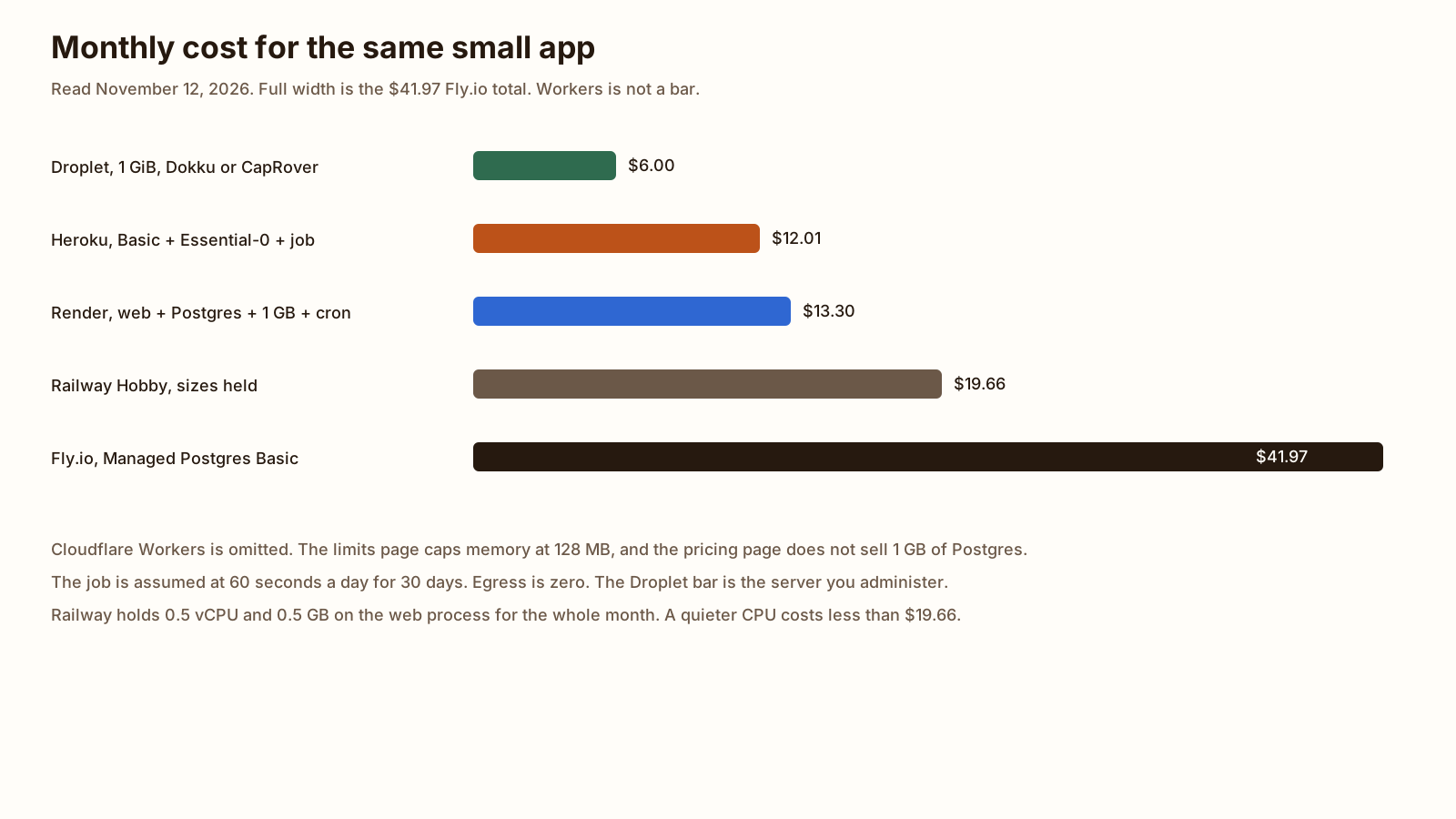
The cheap path is a $6 Droplet you administer. The cheap managed path is Heroku at $12.01. Render is $13.30, Railway Hobby is $19.66, and Fly.io is $41.97.
On this page
The short answer
Pick a 1 GiB DigitalOcean Droplet with Dokku or CapRover when $6 a month and running the server yourself is acceptable. Pick Heroku when you want the managed version of this app: a Basic dyno, Essential-0 Postgres, and a short daily job come to $12.01. Pick Render at $13.30 when you want a fixed instance price, or Railway Hobby at $19.66 when the stated CPU stays busy all month. Fly.io is $41.97 once Managed Postgres Basic is on the bill, and Cloudflare Workers does not sell this 0.5 GB process or this Postgres.
Heroku alternatives are the hosts that can run a small app after a dyno: one web process, Postgres, and a daily job. Heroku alternatives that are free are the free-tier section below: the pricing page read November 12, 2026 lists no $0 dyno. If the app is a Worker or a static site rather than a process that stays on, the ranges are in what it costs to host a small web app.
What we tested
Checked
The prices below are the vendor pages read on November 12, 2026. The app is one always-on web process around 0.5 GB, one Postgres database with 1 GB of disk, and one job that runs 60 seconds a day for 30 days. No account was opened, no app was deployed, and no invoice was paid. A dyno was not timed. Where a page does not print a price for a line, the cell says the line is missing.
What Heroku costs now
The defined app on Heroku is one Basic dyno, one Essential-0 Postgres database, and Heroku Scheduler running that dyno size once a day.
The pricing page lists Basic at $7 a month, 0.5 GB, always on. Eco is $5 a month, also 0.5 GB, personal accounts only, and it sleeps after 30 minutes of inactivity. This app stays on, so the row is Basic, not Eco. Essential-0 Postgres is $5 a month, 1 GB of disk, 20 connections, shared RAM. The RAM cell on that row reads 0 Bytes, so this page does not treat it as a memory allotment. The details column says shared RAM.
Heroku Scheduler, last updated July 24, 2026, is a free add-on. The job runs as a one-off dyno and counts toward monthly usage. The usage page, last updated September 9, 2026, prorates dyno cost to the second and prints Basic at about $0.01 per hour, with a maximum of $7 if it runs all month. The tilde is theirs. A 2 hour example on that page is approximately $0.02.
| Line | Arithmetic | Amount |
|---|---|---|
| Basic dyno | List price. 0.5 GB, always on | $7.00 |
| Essential-0 Postgres | List price. 1 GB disk, shared RAM | $5.00 |
| Scheduler add-on | Free add-on | $0.00 |
| One-off dyno, 30 minutes | 0.5 hour at the printed ~$0.01 per hour. Half a cent, rounded to the cent | $0.01 |
| Heroku total | 7.00 + 5.00 + 0.00 + 0.01 | $12.01 |
The $7 and the $5 match the Heroku prices cited on November 9, 2026 in Vercel vs Railway. That page’s $12 sum has no cron in it. This page adds the one-off line.
The alternatives priced for the same app
One set of assumptions covers every host in the table.
The web process stays on for the whole month at about 0.5 GB of RAM. Where a host sells CPU as its own meter, the row holds 0.5 vCPU, which is Render’s smallest paid web plan (0.5c-512mb, 0.5 CPU and 512 MB). Postgres disk is 1 GB. On Railway the database row also holds 0.25 GB of RAM and 0.1 vCPU, which is Render’s smallest paid Postgres (0.1c-256mb, 256 MB is 0.25 GB). The job runs 60 seconds once a day for 30 days, which is 1,800 seconds, 30 minutes, or 0.5 hour, at the same size as the web process when a size is required. Egress is zero. No tax. No high availability. No second replica. Fly’s machine prices below are the 30-day Ashburn (iad) prices. A 31-day month is slightly more on a per-second host.
Railway’s pricing page prints memory at $10 per GB per month, CPU at $20 per vCPU per month, and volumes at $0.15 per GB per month. The per-second rates next to those constants are $0.00000386 per GB and $0.00000772 per vCPU. Hobby is $5 a month including $5 of usage. The same page says usage of $5 or less bills no extra, and usage past $5 bills the total usage. This table follows that sentence. The 1 GB volume fits on Hobby, whose volume cap is 5 GB. It does not fit on Free or the trial, both capped at 500 MB.
| Line | Arithmetic | Amount |
|---|---|---|
| Render web | Plan 0.5c-512mb, list price | $7.00 |
| Render Postgres | Plan 0.1c-256mb, list price | $6.00 |
| Render storage | 1 times $0.30 | $0.30 |
| Render cron | 30 minutes times $0.00016. Under $0.01 | $0.00 |
| Render workspace | Hobby | $0.00 |
| Render total | 7.00 + 6.00 + 0.30 + 0.00 + 0.00 | $13.30 |
| Railway web memory | 0.5 times $10 | $5.00 |
| Railway web CPU | 0.5 times $20 | $10.00 |
| Railway Postgres memory | 0.25 times $10 | $2.50 |
| Railway Postgres CPU | 0.1 times $20 | $2.00 |
| Railway volume | 1 times $0.15 | $0.15 |
| Railway job | 1,800 seconds at 0.5 GB and 0.5 vCPU, per-second rates, rounds to the cent | $0.01 |
| Railway usage | 5.00 + 10.00 + 2.50 + 2.00 + 0.15 + 0.01 | $19.66 |
| Railway Hobby bill | $19.66 is above the $5 credit, so the bill equals the usage | $19.66 |
| Fly web | shared-cpu-1x, 512 MB, per 30 days, iad | $3.69 |
| Fly Managed Postgres | Basic plan, list price | $38.00 |
| Fly storage | 1 times $0.28 | $0.28 |
| Fly job | 30 minutes of the $3.69 machine. Under $0.01. Stopped rootfs size is not printed, so it is not added | $0.00 |
| Fly total | 3.69 + 38.00 + 0.28 + 0.00 | $41.97 |
| Droplet | Basic, 1 GiB RAM, 1 vCPU, 25 GiB SSD, monthly cap | $6.00 |
| Dokku or CapRover | No separate price on the Droplet page. CapRover’s homepage says free. Dokku’s homepage prints no license fee | $0.00 |
| Droplet total | The Droplet. Cron on the same machine has no second line | $6.00 |
| Workers web, 0.5 GB always on | Workers limits: 128 MB of memory on Free and on the paid column. The shape does not fit | Not priced |
| Workers Postgres, 1 GB | The Workers pricing page does not sell Postgres. Hyperdrive queries an outside database. D1 is a separate meter | Not priced |
| Workers cron | 30 requests fit inside 100,000 a day on Free. This table has no CPU-time reading, so that meter stays blank | Not priced |
| Workers total | Workers Paid is a $5 minimum and still has the 128 MB cap. That fee does not buy the missing lines | Not a complete bill |
-
$6.00
1 GiB Droplet, Dokku or CapRover
-
$12.01
Heroku, Basic, Essential-0, and the job
-
$13.30
Render, smallest paid web and Postgres, plus 1 GB
-
$19.66
Railway Hobby, those sizes held all month
The Railway and Render rate cards, for a web service and Postgres without this job line, are in Railway vs Render. Fly’s pricing page also calls unmanaged Fly Postgres unsupported, and it says a single-node dev cluster is about $2 a month. That “about $2” is not the bill above. The bill uses Managed Postgres Basic, which is the supported product, at $38 plus storage.
Dokku and CapRover are the cheap option because the software is not a second invoice. Dokku’s homepage says you install it on any hardware and push Heroku-compatible apps, which build with Heroku buildpacks. CapRover’s homepage says it is a free, self-hosted PaaS on Docker. The $6 is the 1 GiB Basic Droplet from DigitalOcean’s Droplet pricing, read November 12, 2026. Backups are extra on that page and are not in the $6. You patch the OS yourself.
Railway vs Heroku
Railway vs Heroku, for this app, is $19.66 against $12.01.
Heroku’s $12.01 is three list prices plus a one-cent job: $7 for the dyno that stays on, $5 for 1 GB of Postgres, and about half a cent of one-off time rounded up. The dyno price does not fall when the CPU is idle. Usage and billing says a dyno scaled above zero accrues wall-clock time, not CPU time.
Railway’s $19.66 is the meter with the CPU held. Memory is $5.00, web CPU is $10.00, Postgres memory is $2.50, Postgres CPU is $2.00, the volume is $0.15, and the job is $0.01. Hobby’s $5 is included usage, not a fee stacked on top of that $19.66, because the pricing page says usage past $5 bills the total usage. A process that holds the RAM and the disk and spends no CPU is a smaller bill than this row. This page does not print that quieter total, because the defined app is the busy size.
Railway Free cannot hold the 1 GB volume. The pricing page caps a Free volume at 500 MB, with $1 of usage credit a month. The trial is $5 once, for 30 days, and the volume cap on that row is also 500 MB. Hobby raises the cap to 5 GB.
A Next.js app, Postgres, and a cron, priced as Vercel against Railway on a different footprint, is Vercel vs Railway. This page does not reprice Vercel.
Which to pick by app type
- You will administer a Linux server, and $6 is the budget: a 1 GiB DigitalOcean Droplet with Dokku or CapRover. The software does not add a second line. Backups are not in the $6.
- You want the closest managed replacement, always on, with Postgres on the same account: Heroku. Basic plus Essential-0 plus the short job is $12.01.
- You want a fixed instance price that does not sleep and does not move when the CPU is idle: Render. $13.30 on a Hobby workspace.
- You want one meter, and you can watch the CPU: Railway Hobby. $19.66 at the sizes in the table. A quieter CPU costs less. The 1 GB disk waits until Hobby.
- The database budget can absorb Managed Postgres: Fly.io, $41.97. The web machine alone is $3.69 per 30 days. The $38 Basic plan is the rest.
- The app is a Worker, not a 0.5 GB process: Cloudflare Workers vs Pages. Postgres on that architecture is a database host, compared in Neon vs Supabase.
- You want Postgres plus Auth, files, and an API, and you are comparing that project with a Railway volume: Railway vs Supabase. The workload there is the database, not the dyno plus the daily job on this page.
- The thing you are hosting is a static site: Netlify vs Cloudflare Pages.
- You are choosing between Vercel and Netlify for a small site: Vercel vs Netlify.
Migrating off Heroku
The build, the config, and the database are three separate moves.
Heroku buildpacks do not travel as a platform setting. Dokku still builds Heroku-compatible apps with Heroku buildpacks, which is why it is the shortest path if you are leaving the bill and keeping the build. Railway’s builds page says a Dockerfile in the repo is used automatically. The zero-config builder on the Railpack page analyzes the code, installs the runtime, and packages a container image. The docs URL that used to be Nixpacks now returns that Railpack page, so this post does not tell you to add a Nixpacks file.
Config vars are exposed to the app as environment variables. heroku config prints them. Copy the names and values into the new host’s environment. Railway’s Railpack page is one place that calls those environment variables. Do not paste a secret into a git repo while you do it.
Postgres export is on Heroku’s import and export page, last updated January 13, 2026. heroku pg:backups:capture creates a backup of DATABASE_URL, and heroku pg:backups:download fetches the latest one. The file is pg_dump custom format. A plain-text dump is pg_dump -Fp --no-acl --no-owner. Restore with pg_restore --no-acl --no-owner. If the restore complains about heroku_ext, the page says to run CREATE SCHEMA heroku_ext; first. The new host still needs its own empty database before that restore.
Free tiers and what is gone
Heroku’s help center FAQ says free dynos, free Heroku Postgres, and free Heroku Key-Value Store plans were removed starting November 28, 2022. The pricing page read today has no $0 dyno and no $0 Postgres. Eco, at $5 for 1,000 hours, is the plan that sleeps. Basic, at $7, is the plan that stays on. When Eco hours hit 100 percent, dynos sleep for the rest of the month and you cannot buy more hours.
Railway Free is $0 with $1 of usage credit. A 0.5 GB of memory held all month is $5.00 before CPU and disk, which is more than the $1 credit. The 1 GB volume does not fit under the 500 MB cap. Render’s free web service is $0 and spins down after 15 minutes without inbound traffic, with 750 free instance hours a workspace each month. Free Render Postgres is one database per workspace, 1 GB fixed, and it expires 30 days after creation. The free page says free databases do not support backups. Fly.io’s pricing page says new organizations have no free tier. The trial is $1 of credit for 7 days. A personal organization’s bill under $5 is waived, which does not cover the $41.97 above.
Workers Free is $0 and includes 100,000 requests a day. It does not include a 0.5 GB process. The limits page caps memory at 128 MB on Free and on the paid column. Workers Paid has a $5 minimum and the same 128 MB cap. That is why the table has no Workers total.
Railway vs Render The rate cards for one always-on web service and 1 GB of Postgres, without the Heroku dyno or the daily job line on this page. Blog Vercel vs Railway A Next.js app, Postgres, and one cron, on a different footprint than the $19.66 row here. Blog Neon vs Supabase Hosted Postgres when the app server is not the database, including the database a Worker does not include. BlogFAQ
Is Heroku still free?
No. The Heroku pricing page read November 12, 2026 lists no $0 dyno. The cheapest dyno on that page is Eco at $5 a month for 0.5 GB, personal accounts only, and it sleeps after 30 minutes. The Eco plan is 1,000 dyno hours shared across the account. A Basic dyno, which stays on, is $7 a month. Essential-0 Postgres is $5 a month.
What replaced the Heroku free tier?
Heroku’s help center FAQ says free dynos, free Heroku Postgres, and free Heroku Key-Value Store plans were removed starting November 28, 2022. The same date is on the Heroku blog post Next Chapter. The low-priced plan on the pricing page today is Eco: $5 for 1,000 dyno hours, personal accounts only, sleeping after 30 minutes with no web traffic. It is not a $0 plan. When the hours run out, Eco dynos sleep until the next month, and you cannot buy more hours.
What is the cheapest Heroku alternative?
For this app, a 1 GiB DigitalOcean Basic Droplet at $6 a month, with Dokku or CapRover on it. You administer the server. CapRover’s homepage says the software is free. Dokku’s homepage does not print a license fee. The cheapest managed bill in the table is Heroku at $12.01: a Basic dyno, Essential-0 Postgres, the free Scheduler add-on, and a short daily one-off dyno. Render is $13.30. Railway Hobby is $19.66 at the sizes held below.
Heroku vs Railway?
Heroku is $12.01 for this app. Railway Hobby is $19.66 if the web process holds 0.5 vCPU and 0.5 GB, and Postgres holds 0.1 vCPU, 0.25 GB, and a 1 GB volume, for the whole month, plus the daily job. Heroku’s $7 and $5 are list prices. Railway’s number is a meter, so a quieter CPU costs less. A Next.js illustration with a different footprint is in Vercel vs Railway. The Railway vs Heroku section on this page is the comparison for this shape.
Can I self-host a Heroku alternative?
Yes. Dokku’s homepage calls it an open source PaaS alternative to Heroku, and it builds with Heroku buildpacks. CapRover’s homepage says it is free and self-hosted. Either one sits on a VM. The VM in this table is DigitalOcean’s 1 GiB Basic Droplet at $6 a month, which has 25 GiB of SSD, enough for the 1 GB database. A 512 MiB Droplet is $4 and is smaller than a 0.5 GB web process plus Postgres, so it is not the row used here.
Sources
- Heroku pricing Checked
- Usage and billing (Heroku) Checked
- Heroku Scheduler Checked
- Eco dyno hours (Heroku) Checked
- Removal of Heroku Free Product Plans FAQ Checked
- Heroku Next Chapter Checked
- Config vars (Heroku) Checked
- Importing and exporting Heroku Postgres Checked
- Railway pricing Checked
- Cron jobs (Railway) Checked
- Builds (Railway) Checked
- Railpack (Railway) Checked
- Render pricing Checked
- Deploy for free (Render) Checked
- Fly.io resource pricing Checked
- Managed Postgres overview (Fly.io) Checked
- Workers pricing (Cloudflare) Checked
- Workers limits (Cloudflare) Checked
- Droplet pricing (DigitalOcean) Checked
- Dokku Checked
- CapRover Checked