
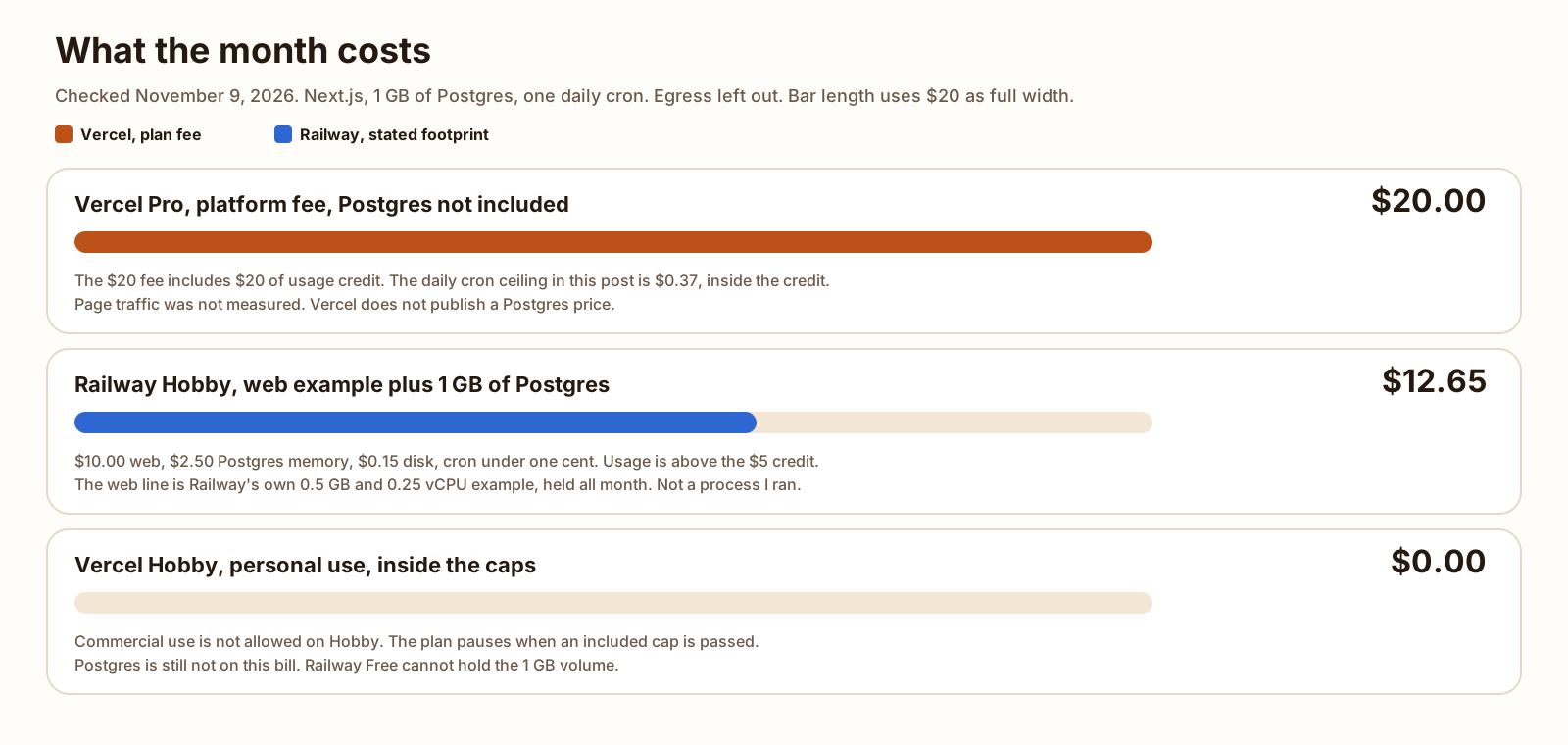
Vercel Pro is $20 before a database. The Railway Hobby illustration is $12.65, and that number includes 1 GB of Postgres. Pages read November 9, 2026.
On this page
The short answer
Pick Vercel if the app is commercial and you will pay the $20 Pro fee, with Postgres priced somewhere else, because Vercel does not sell it, or if it is personal use inside the Hobby caps, at $0 until a cap. Pick Railway if you want the Next.js process, 1 GB of Postgres, and one daily cron on one meter. On the illustration, Railway Hobby is $12.65 with the stated CPU, or $7.65 with web CPU at zero, and Railway Free cannot hold that 1 GB disk.
Vercel vs Railway is a host choice for a small Next.js app that also needs Postgres and a cron job, and Railway vs Vercel is the same choice. Where that month sits among the other hosts is in what a small web app costs to host. It lives on the backend and stack hub. The reader wants a monthly number, the free tier, and whether the process stays on. Those Railway rates, and a Render total for a different shape, are in Railway vs Render. This page does not reprice Render.
What we tested
Checked
Pages read on November 9, 2026. Every dollar below is a reading of the vendor pages, or arithmetic on those rates. Where a page does not publish a figure, the cell says so. No deploy of either host, no invoice, and no Git repo connected. Builds were not timed, and a cold start was not measured. A WebSocket was not opened. Vercel cron and Schedules were not created. The log viewers were not compared. Heroku was not deployed. The Railway Postgres template was not opened. Vercel page requests were not measured. The deploy steps further down are the ones Railway prints, not a migration that was run. The data copy off Marketplace Postgres was not done. The timed request in the Vercel vs Netlify post was not repeated.
Pricing compared
The defined app is one Next.js production app, one Postgres database with 1 GB stored, and one cron job that runs once a day. Egress is zero in the arithmetic. No tax. No second replica. No high availability. The cron count is 30 runs, for a 30-day stretch. A 31st run is one more minute on Railway and one more invocation on Vercel, and neither moves the cent totals below.
Vercel prices are in USD and exclude VAT and GST, on the pricing docs and on the plan pages. The worked Vercel column uses Washington, D.C. (iad1). On the fluid pricing page and the iad1 page, active CPU there is $0.128 per hour and provisioned memory is $0.0106 per GB-hour. Cleveland and Portland print the same two rates. São Paulo, the dearest row on that table, is $0.221 and $0.0183. The pricing page prints the floor as “starting at” those iad1 numbers.
Railway prices come from the pricing page and the plans page. Memory is $10 per GB-month, CPU is $20 per vCPU-month, and volume storage is $0.15 per GB-month. The plans page also prints memory at $0.000231 per GB per minute. The cron line uses that rate. The always-on lines use the monthly constants. Billing is per second, so a stopped service costs nothing. The monthly column is what a resource costs if it is held for the whole billing month.
The plan fee is a credit toward usage, not a second charge stacked on top of a full usage bill. The plans page gives the Hobby examples. Usage of $3 bills $5, the subscription alone. Usage of $7 bills $7, which is the $5 subscription plus $2 over the credit. The docs overview says usage of $3 bills $5 and usage of $8 bills $8. The pricing page says the same thing in the Hobby FAQ: usage of $5 or less bills no extra, and usage past $5 bills the total usage. One sentence on that same pricing page says resource consumption is billed in addition to the plan fee. Read with the examples, “in addition” means the part past the included credit, not a second copy of the whole meter. This post follows the examples. It assumes the Hobby fee is not waived. The plans page says Railway waives that fee for a small set of builders, picked automatically, and that asking does nothing.
Vercel Pro, on the Pro plan page, is a $20 a month platform fee. The fee includes one deploying seat and $20 of usage credit. The credit applies to managed infrastructure from the first unit, expires at the end of the month, and usage past it is billed on demand. A meter inside the credit does not add a second charge, so the bill stays $20. A meter of $25 would be the $20 fee plus $5 on demand. That is a reading of “additional usage,” not an invoice. An extra deploying seat is $20 a month. Viewer seats are free. Railway Pro is $20 a month per workspace, including $20 of usage, and the pricing page says seats are unlimited and included. The seat is the difference, not the $20.
| Line | Vercel | Railway |
|---|---|---|
| Plan under this comparison | Pro, $20 a month, including $20 of usage credit and one deploying seat. Hobby is $0 and personal use only | Hobby, $5 a month, including $5 of usage. The bill below assumes the fee is not waived |
| Next.js compute | Fluid functions. iad1 active CPU $0.128 per hour. Provisioned memory $0.0106 per GB-hour. Nothing between requests | A service that stays up. Memory $10 per GB-month. CPU $20 per vCPU-month. Held all month unless you stop it or enable Serverless |
| Default function size | 2 GB and 1 vCPU. Hobby cannot change it. Pro can go to 4 GB and 2 vCPU | No fixed size. You pay what the process holds, up to 48 vCPU and 48 GB on Hobby |
| Postgres | No price. Vercel Postgres moved to Neon in December 2024. New databases come from the Marketplace | A template service plus a volume. Same CPU and memory rates. Volume $0.15 per GB-month |
| 1 GB of disk | Unpublished. Not a Vercel SKU | $0.15. Fits on Hobby, where the volume cap is 5 GB. Does not fit on Free or the trial, where the cap is 0.5 GB |
| One daily cron | Included. The run is a function invocation. Hobby cron jobs can run once per day | No separate fee. The service is billed only while it runs. Runs must be at least 5 minutes apart |
| Egress | Fast Data Transfer. Pro includes a flat-rate CDN tier. iad1 on-demand is $0.15 per GB | $0.05 per GB. No included gigabytes on the pricing table |
The worked month
Two assumptions are labeled so they are not mistaken for a deploy.
On Railway, the web service uses the footprint in Railway’s own idle-cost guide: 0.5 GB and 0.25 vCPU, held all month. The guide calls that “about $10”. The rates multiply to $10.00. Postgres holds 0.25 GB of memory, CPU at zero, and a 1 GB volume. The 0.25 GB is an illustration of a small database, not a default read off a screen. The cron holds 0.5 GB, uses no CPU, runs for 1 minute, and exits. The 1 minute is an assumption. Railway does not publish a duration. Serverless is off. A database is a bad fit for that toggle, and an open Postgres connection counts as outbound traffic, so the service would not sleep anyway.
On Vercel, the cron ceiling uses the published caps, not a trace. The memory default is 2 GB. Each of 30 runs is assumed to stay in progress for the Hobby maximum of 300 seconds, with the CPU active the whole time. That is the expensive end of a daily job, not a typical one. Page requests are not in the dollar total. Postgres is not in the dollar total. Vercel does not publish a price.
| Line | Arithmetic | Amount |
|---|---|---|
| Vercel Pro fee | Platform fee, one deploying seat, $20 credit | $20.00 |
| Vercel cron CPU, ceiling | 30 times 300 seconds is 2.5 hours, times $0.128 | $0.32 |
| Vercel cron memory, ceiling | 2 GB times 2.5 hours is 5 GB-hours, times $0.0106 | $0.053 |
| Vercel cron invocations | 30 divided by 1,000,000, times $0.60 | $0.000018 |
| Vercel cron ceiling | 0.32 plus 0.053 plus 0.000018 | $0.373018 |
| Vercel Postgres | No published price | Not in the bill |
| Vercel page traffic | Not measured | Not in the bill |
| Vercel Pro bill | $0.37 of cron is inside the $20 credit, so the bill is the fee | $20.00 |
| Railway web memory | 0.5 times $10 | $5.00 |
| Railway web CPU | 0.25 times $20 | $5.00 |
| Railway Postgres memory | 0.25 times $10 | $2.50 |
| Railway Postgres CPU | Held at zero in this illustration | $0.00 |
| Railway volume | 1 times $0.15 | $0.15 |
| Railway cron | 0.5 GB times 30 minutes times $0.000231 | $0.003465 |
| Railway usage | 5 plus 5 plus 2.50 plus 0 plus 0.15 plus 0.003465 | $12.653465 |
| Railway Hobby bill | Usage is above the $5 credit, so the bill equals the usage, to the cent | $12.65 |
| Check | Arithmetic | Amount | In the text |
|---|---|---|---|
| Railway usage past the credit | 12.653465 minus 5 | $7.653465 | $7.65 |
| Credit plus that overage | 5 plus 7.653465 | $12.653465 | $12.65 |
| Railway usage without the cron | 12.653465 minus 0.003465 | $12.65 | $12.65 |
| Railway CPU at zero | 5.00 plus 2.50 plus 0.15 plus 0.003465 | $7.653465 | $7.65 |
| Vercel cron ceiling, São Paulo | 2.5 times 0.221, plus 5 times 0.0183, plus 0.000018 | $0.644018 | $0.64 |
| $20 credit in active CPU hours | 20 divided by 0.128 | 156.25 hours | 156.25 hours |
| $20 credit in GB-hours | 20 divided by 0.0106, to the nearest hundredth | 1,886.79 GB-hours | 1,886.79 GB-hours |
| $20 credit in invocations | 20 divided by 0.60 | 33.33 million | 33.33 million |
| Railway Free memory, no CPU, no disk | 0.5 times 10 | $5.00 | $5.00 |
Check the Railway bill against the plans-page rule. Usage past the $5 credit rounds to $7.65, and the Hobby bill rounds to $12.65. The cron does not change the cent. Drop it and the rest is $12.65 exactly.
The same Railway memory and disk, with the web CPU also at zero, rounds to $7.65. That floor matches the CPU-at-zero column in the Railway vs Render post, because the memory and the 1 GB disk are the same illustration and the cron still does not move the cent. The $12.65 on this page is the one that uses Railway’s published 0.5 GB and 0.25 vCPU example.
The Vercel cron ceiling in São Paulo rounds to $0.64. It is still inside the $20 credit. Region does not change the $20 for this cron ceiling. A month of real page traffic can. Spent on one iad1 meter and nothing else, the $20 credit covers 156.25 active CPU hours, 1,886.79 GB-hours, or 33.33 million invocations. The fluid pricing table prints “N/A” in the Pro on-demand invocations cell. The same page’s example, the pricing page (“starting at $0.60 per 1M”), and the fair use page ($0.60 per 1,000,000 once the credit is used) are the figures this arithmetic uses.
Pro’s plan page says the lowest Flat Rate CDN tier is included at no extra cost: 1,000,000 CDN requests and 1 TB of data transfer a month. The pricing page says Pro includes 10,000,000 CDN requests and 1 TB of Fast Data Transfer, then starting at $2 per 1,000,000 requests and $0.15 per GB. A small app under 1,000,000 CDN requests and under 1 TB is inside both readings, and neither reading puts that transfer on the $20 credit. iad1 on-demand, after the included tier, is $0.15 per GB and $2 per 1,000,000 CDN requests. Those rates are not in the $20.
-
$20.00
Vercel Pro, cron ceiling inside the credit, no Postgres
-
$12.65
Railway Hobby, stated web example plus 1 GB of Postgres
-
$7.65
Railway Hobby, same memory and disk, CPU at zero
-
$0.00
Vercel Hobby, personal use, inside the caps, no Postgres
Builds are not in either total. Railway’s plans page says service builds are free, including build CPU and memory. Vercel’s pricing page says Hobby basic build machines are included, and Pro lists Elastic machines at $0.0035 per CPU minute, up to Turbo at $0.105 per minute. There is no build length on this page to multiply.
The idle-cost guide’s savings example is not this bill. It says a service at 0.5 GB and 0.25 vCPU that is only active 8 hours a day on weekdays is roughly 24 percent of the month, so about $2.40 instead of about $10, if Serverless is on. The worked month leaves the toggle off. A Postgres connection, or Next.js telemetry, keeps the service awake even if you turn the toggle on.
Serverless functions vs always-on services
Vercel runs the Next.js server as functions. On the fluid pricing page, an instance starts when a request arrives, bills provisioned memory until the last in-flight request finishes, and bills active CPU only while the code is actually running. Waiting on a database pauses the CPU charge and does not pause the memory charge. After the requests finish, the instance pauses, and CPU and memory charges stop until the next request. You do not pay for an idle hour with no requests. You do pay for the memory of a request that is stuck on I/O, and a WebSocket that stays open is a request that is still in progress.
The Hobby plan caps function duration at 300 seconds, which is also the default. Pro can raise it to 800 seconds, and an extended maximum of 1,800 seconds is in beta. The memory page sets the current default at 2 GB and 1 vCPU. Hobby cannot change that size. Projects created before November 8, 2019 keep an older default, and this bill does not use that older size.
Railway runs the Next.js server as a long-running container. The process stays up, and the bill is the memory and CPU it holds, per second. There is no 300 second or 800 second request cap on that service. Railway’s comparison guide, last updated June 2026 and still the page on November 9, says there is no cold start, because there is no function instance to create per request.
Serverless on Railway is a per-service toggle, not the default. The idle-cost guide says the service sleeps after 10 minutes with no outbound packets, a slept service accrues no compute, and the first request can return a 502. Outbound packets include open database connections, Next.js telemetry, private-network calls, and NTP. The guide says to set NEXT_TELEMETRY_DISABLED to 1 if you want a Next.js app to be able to sleep. The worked month does not turn the toggle on.
WebSockets are the row the two vendors do not agree on. Vercel’s websocket page, read November 9, 2026, says WebSockets are available on all plans, a connection is pinned to one function instance, and the connection closes when the function reaches its maximum duration. Fluid compute has to be on, and it is the default for new projects created on or after April 23, 2025. The same page says Next.js does not expose an upgrade API, and the workaround is upgradeWebSocket from @vercel/functions version 3.10.0 or later. Railway’s comparison table says persistent connections are unsupported on Vercel. That table disagrees with the Vercel page. For a socket that must stay open for hours, Railway’s long-running process does not have the 300 second or 800 second cap.
A long-running job has the same split. On Vercel the function is terminated at its maximum duration. On Railway a worker is an ordinary service, billed while it runs, or a cron service that must exit. The comparison guide lists ETL, media, and report jobs as work it says Vercel functions are the wrong fit for. The duration numbers above are Vercel’s. The “wrong fit” sentence is Railway’s.
If the app is a static site or a Worker, rather than a process that stays up, the host choice is Cloudflare Workers vs Pages. If the serverless choice is Workers or Vercel Functions, with one worked month, that comparison is Cloudflare Workers vs Vercel. If the choice is still two Git frontends, the prices and a TTFB check are Vercel vs Netlify. Netlify against Cloudflare Pages, on credits and static requests, is Netlify vs Cloudflare Pages.
Databases, cron and background jobs
Vercel does not sell Postgres. The Postgres page says Vercel Postgres is no longer available, existing databases were moved to Neon in December 2024, and a new project installs a Marketplace integration. The providers named on that page are Neon, Prisma Postgres, Supabase, and AWS Aurora Postgres. None of those prices are on the Vercel pricing page, so none of them are in the $20. A hosted Postgres bill, for a product that can suspend or one that includes auth, is Neon vs Supabase and Supabase vs Firebase. A Railway container against a hosted Supabase project is Railway vs Supabase. This page does not reprice Supabase.
Railway Postgres is a template you add from the project canvas. The Postgres page says the image is Railway’s SSL-enabled build on the official Postgres image, and that the service exposes DATABASE_URL plus the usual PGHOST, PGPORT, PGUSER, PGPASSWORD, and PGDATABASE variables. It is private by default. Public access is a TCP proxy, and that page says you are billed for network egress when you use the proxy. The $12.65 assumes you do not. High availability, backups, and point-in-time recovery are separate steps on that page. They are not in the $12.65. The default shared-memory size on that page is 64 MB. That is a container setting, not a price.
The disk is a volume at $0.15 per GB-month. Hobby allows 5 GB, so the 1 GB in this post fits. Free and the trial cap a volume at 0.5 GB, on the pricing page and the plans page, so the 1 GB disk does not fit until Hobby.
Cron on Vercel has no price of its own. The cron usage page says cron jobs are included on all plans, and the run invokes a function, so the function meters apply. Hobby can schedule 100 cron jobs per project, each at most once per day, and the run can land any time inside the scheduled hour. Pro can schedule once a minute, with per-minute precision. A newer product, Schedules, is in beta. On Hobby it allows a cron at most every 15 minutes, with a 15-minute jitter window, and a team can run schedules up to 5,000 times per billing period. The defined job is once a day, so it fits the legacy Hobby rule and the beta rule.
Cron on Railway is a service setting, not a second SKU. The cron page says you put a crontab expression on the service, Railway starts the start command on that schedule, and the process is expected to exit and close its database connections. If a previous run is still active, the next run is skipped, not killed. Schedules are UTC. The gap between runs must be at least 5 minutes. A daily job meets that gap. The page does not print a cron fee. The $0.003465 line is the memory rate times an assumed 1 minute, not a charge the page lists.
Background work that must not be killed at 300 or 800 seconds is a Railway service or a Railway cron that exits. Vercel also sells Workflows and Queues. The pricing page lists Workflow events at 50,000 a month on Hobby and $20 per 1,000,000 on Pro, and Queue API operations at 1,000,000 included on Hobby and starting at $0.60 per 1,000,000 on Pro. The defined app does not use them, so they are not in the $20.
Free tiers and limits
A commercial app cannot start on Vercel Hobby. The fair use guidelines, read November 9, 2026, restrict Hobby to non-commercial personal use. Commercial use includes taking a payment, advertising a product, being paid to build or host the site, a site whose primary purpose is affiliate links, and ads. Asking for donations is not commercial use. Pro or Enterprise is the commercial plan.
Hobby, when you are allowed to use it, includes 100 GB of Fast Data Transfer, 10 GB of Fast Origin Transfer, 1,000,000 CDN requests, 4 active CPU hours, 360 GB-hours of provisioned memory, and 1,000,000 function invocations. The Hobby page says there is no billing cycle. In most cases, passing a limit means waiting 30 days before you can use that feature again. The cron ceiling on this page is 2.5 CPU hours, 5 GB-hours, and 30 invocations, which fits inside those three caps. Passing a cap still pauses the feature. You cannot buy the overage on Hobby.
Railway Free is $0 with $1 of usage credit a month. The pricing page caps a Free service at 1 vCPU and 0.5 GB, one replica, and a 0.5 GB volume, with one project, three services, and zero custom domains. The 1 GB disk does not fit. Half a gigabyte of memory held all month, with no CPU and no disk, is $5.00. The $1 credit is one fifth of that memory line. The trial is $5 of credit once, for 30 days, and no card. The plans page caps the trial volume at 0.5 GB as well, so the defined disk does not fit on the trial either. Hobby raises the volume cap to 5 GB and includes two custom domains. Log history on the pricing page is 3 days on Free and 7 days on Hobby.
The two free tiers do not run this post’s shape for a month you can ignore. Vercel Hobby refuses commercial use, and it has no Postgres. Railway Free and the trial refuse the 1 GB volume, and $1 of credit does not cover half a gigabyte of memory for the month.
Vercel runtime logs, on the pricing page, are 1 hour on Hobby and 1 day on Pro. That is a shorter window than Railway Hobby’s 7 days.
Deploy experience and moving from Vercel to Railway
The steps below are the ones Railway prints.
Railway’s comparison guide says to move an app like this:
- Create an account. A new account can start on the trial, $5 once, for 30 days, with no card. The 1 GB volume still waits until Hobby.
- Choose “Deploy from GitHub repo”, connect GitHub, and select the repo.
- Open the service, then Variables. Add each variable, or use Raw Editor to paste an env file.
- Open Settings, then Networking. Generate a Railway domain, which the page says is served under
.up.railway.app, or add a custom domain and follow the DNS steps. Hobby includes two custom domains. Free includes zero. - Add Postgres from the canvas. Read
DATABASE_URL. Leave the database private unless you need the TCP proxy. Point the app at that variable. - For the daily job, open the cron service, set the crontab, and make the process exit. A Vercel cron that ran every minute does not fit. Railway skips a run if the previous one is still active, and the gap must be at least 5 minutes. A daily Hobby cron already fits.
What does not move unchanged is the runtime. A Vercel function that counted on a 300 second cap is now a process you either keep running or start from cron and exit. Marketplace Postgres can stay where it is. You do not have to move Neon or Supabase onto a Railway volume to leave Vercel. If you do move it, the volume price is the $0.15 line above.
A DigitalOcean Droplet is the other end of the same choice: a virtual machine you administer, rather than a function or a Railway service. Railway vs DigitalOcean is a platform against a VM. This page does not price DigitalOcean.
The Git-frontend version of the deploy, including build caps and a timed request to each vendor’s public starter, is Vercel vs Netlify.
When to pick which
Pick Vercel if the app takes payment, shows ads, or you are paid to build it, and the database is priced somewhere else. The fee is $20, and the daily cron ceiling on this page stays inside the credit. Pick Railway if you want the Next.js process, Postgres, and the cron on one bill. The illustration is $12.65, or $7.65 with web CPU at zero.
- The app takes payment, shows ads, or you are paid to build it, and you want Vercel: Pro. The fee is $20. The daily cron ceiling on this page stays inside the credit. Budget a database on top. Vercel does not publish that price.
- The app is personal, stays inside the Hobby caps, and the database lives somewhere else: Vercel Hobby at $0. Commercial use is outside the fair use page.
- You want the Next.js process, Postgres, and the cron on one bill, and you can live with a meter: Railway Hobby. The illustration is $12.65. CPU at zero, same memory and disk, is $7.65. A quieter process costs less, and a busier one costs more.
- The 1 GB disk has to exist before you add a card: it does not fit on Railway Free or the trial. Both cap a volume at 0.5 GB.
- The job runs longer than 800 seconds, or a WebSocket has to stay open for hours: Railway. Vercel closes the function, and the socket, at the maximum duration.
- The site is static, or it is a Worker: Cloudflare Workers or Pages. Not this page.
- The database should suspend, or it should include auth: Neon or Supabase. Not a Railway volume.
- You are comparing Railway with Heroku: a Basic dyno plus Essential-0 Postgres is $12 on the Heroku page, with no cron in that sum. The worked month that adds the daily job, Render, Fly.io, and a small VPS is Heroku alternatives.
The $20 and the $12.65 are the decision on this page, and they are not the same kind of number. The $20 is a platform fee with the database missing. The $12.65 is a meter on the stated footprint, with the database included. Read the usage screen for a week before you treat $12.65 as an invoice.
Railway vs Render, real pricing for a small app The Railway rate card, and a Render list price for one always-on web service plus 1 GB of Postgres. Blog Vercel vs Netlify, pricing and a TTFB check Free caps, paid plans, and a timed request to each vendor's public Astro starter. Blog Neon vs Supabase, free tier and the first paid month Hosted Postgres, including the kind of database Vercel no longer sells itself. BlogFAQ
Is Railway cheaper than Vercel?
On the illustration dated November 9, 2026, Railway Hobby is $12.65 and Vercel Pro is $20. The Railway figure includes 1 GB of Postgres. The Vercel figure does not, because Vercel does not publish a Postgres price. A personal project that stays inside Vercel Hobby caps is $0, and Railway Free cannot hold a 1 GB volume. These are readings of the price pages plus arithmetic, not invoices. Request traffic on Vercel was not measured, so a busy function month can pass the $20 credit and raise the Vercel bill.
Can you host Next.js on Railway?
Yes. Railway runs the app as a long-running service, not as a serverless function. The comparison guide, read November 9, 2026, says to deploy the GitHub repo, add variables, and attach a domain. The idle-cost guide tells you to set NEXT_TELEMETRY_DISABLED so Next.js telemetry does not keep a slept service awake.
Does Railway use AWS?
Not for the app. Railway Metal is hardware Railway owns and operates, and the metal FAQ says Railway is leaving GCP. AWS Marketplace is a way for an enterprise to buy a Railway contract. That page lists a 12-month contract at $10,000, which is not the Hobby bill. The containers in that contract still run on Railway Metal.
Railway vs AWS: which is simpler?
For this small app, Railway. One project holds the Next.js service, the Postgres template, and the cron schedule. AWS is the set of services you would assemble yourself. This page does not price EC2, RDS, or a scheduler. Vercel’s pricing page lists a separate Enterprise option to run Vercel compute inside your own AWS account. That option is not Railway, and it is not on the Hobby or Pro rows.
Railway vs Heroku?
Both keep a process running. On the Heroku pricing page read November 9, 2026, a Basic dyno is $7 a month for 0.5 GB and stays on, and Essential-0 Postgres is $5 a month with 1 GB of disk. Those two lines add to $12. Eco is $5 for 0.5 GB, personal accounts only, and sleeps after 30 minutes. Railway Hobby on this page’s illustration is $12.65, and the CPU line falls when the process is idle. The Heroku sum has no cron in it. The same dyno and database, plus a daily job and the other hosts, are in Heroku alternatives.
Sources
- Vercel pricing Checked
- Pricing on Vercel Checked
- Vercel Hobby plan Checked
- Vercel Pro plan Checked
- Fair use guidelines (Vercel) Checked
- Regional pricing (Vercel) Checked
- Washington D.C. (iad1) pricing (Vercel) Checked
- Fluid compute pricing (Vercel) Checked
- Configuring memory for Vercel Functions Checked
- Usage and pricing for Cron Jobs (Vercel) Checked
- Schedules limits (Vercel) Checked
- Postgres on Vercel Checked
- WebSockets (Vercel) Checked
- Railway pricing Checked
- Railway pricing (docs overview) Checked
- Plans (Railway) Checked
- Cut idle costs with Serverless (Railway) Checked
- Cron Jobs (Railway) Checked
- PostgreSQL (Railway) Checked
- Railway Metal Checked
- Railway vs Vercel (Railway) Checked
- AWS Marketplace (Railway) Checked
- Heroku pricing Checked