
Pick Cloudflare Pages for headers, path redirects, or a function. Pick GitHub Pages for a public repo on github.io. The limits are the vendor pages on November 11, 2026.
On this page
The short answer
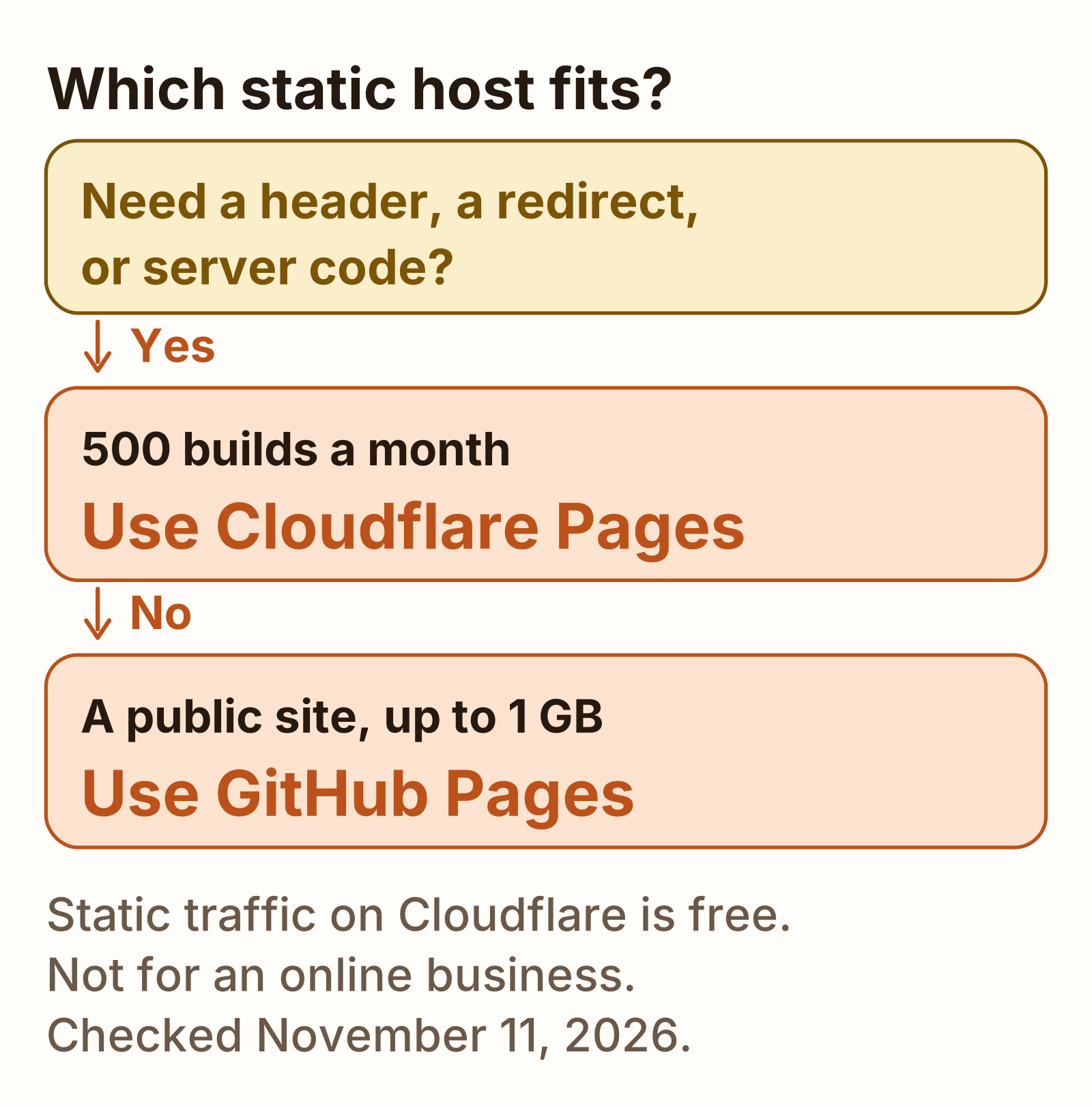
Cloudflare Pages vs GitHub Pages: pick Cloudflare Pages if you need a custom header, a path redirect, or server-side code, because the Free plan allows 500 builds a month and static asset requests are free and unlimited. Pick GitHub Pages if the site is a public repository and github.io is enough: the published site may be no larger than 1 GB, and bandwidth is a soft 100 GB a month. A private repository is not on GitHub Free. The GitHub limits page says Pages is not for an online business, an e-commerce site, or commercial software as a service.
Cloudflare Pages vs GitHub Pages is the static-host choice when the site is files in a Git repo, and GitHub Pages vs Cloudflare Pages is the same choice. The wider hosting bill, including Pages, is in app hosting cost for a small web app. The rest of the hosting comparisons are on the backend and stack hub.
Free limits side by side
Every cell is a vendor page read on November 11, 2026. Where a page does not print a figure, the cell says so. Cloudflare dates below are the “Last updated” line on that page. The GitHub docs I fetched do not print a last-updated line, so those cells are the November 11 reading only.
| Line | Cloudflare Pages | GitHub Pages |
|---|---|---|
| Bandwidth | Static asset requests are free and unlimited on free and paid plans, when the request does not invoke Functions. Functions pricing, last updated September 8, 2026. The limits page does not print a gigabyte cap. | A soft bandwidth limit of 100 GB a month. Going past a quota can mean the site is not served, or an email from GitHub Support. |
| Site size and files | Free: 20,000 files. Paid plans: up to 100,000 files after you set PAGES_WRANGLER_MAJOR_VERSION=4. One file: 25 MiB. The limits page does not print a total gigabyte cap. | Published sites may be no larger than 1 GB. Source repositories have a recommended limit of 1 GB. The limits page does not print a file count or a per-file cap. |
| Builds per month and timeout | Free: 500 builds a month, 1 at a time. Pro: 5,000 a month, 5 concurrent. Business: 20,000 a month, 20 concurrent. Timeout: 20 minutes. Concurrent builds are counted per account. The Pages index calls the Free figure 500 deploys a month. This table uses the limits page, which says builds. | Deployments time out after 10 minutes. A soft limit of 10 builds an hour. That hourly limit does not apply if you build and publish with a custom GitHub Actions workflow. The limits page does not print a monthly build count. |
| Sites per account | 100 projects per account. The page says this limit is not routinely increased. New accounts can be blocked from creating projects for the first 48 hours. The block lifts on its own. | One user or organization site per account, from a repository named owner.github.io. One project site per repository, at owner.github.io/repository. GitHub Free includes unlimited public repositories. |
| Custom domains and HTTPS | Custom domains per project: 100 on Free, 250 on Pro, 500 on Business, 500 on Enterprise. An apex domain needs the zone on Cloudflare nameservers. A subdomain can be a CNAME to the pages.dev hostname without moving nameservers. Pages issues the certificate. CAA records must allow it. Pages manages TLS for that hostname, and you cannot set the minimum TLS version yourself. Custom domains page, last updated November 11, 2026. | www subdomains, other subdomains, and apex domains. All sites, including custom domains, support HTTPS, and an admin can enforce it. github.io sites created after June 15, 2016 are served over HTTPS automatically. Custom-domain certificates come from Let’s Encrypt. The whole domain must be under 64 characters or the certificate is not created. |
| Redirects | A _redirects file: 2,000 static and 100 dynamic, which the page states as a combined 2,100. Status codes 301, 302, 303, 307, and 308. The default is 302. Redirects are not applied to requests served by Functions. Redirects page, last updated August 25, 2026. | If both the apex and www DNS records are set, GitHub Pages creates redirects between them. The dependency list at pages.github.com/versions.json, fetched November 11, 2026, includes jekyll-redirect-from 0.16.0. It is not in the enabled-by-default plugin list. The GitHub Pages docs read today do not document a _redirects file. |
| Custom headers | A _headers file: 100 header rules. One header: 2,000 characters. Headers in that file are not applied to Function responses. Headers page, last updated August 25, 2026. Serving Pages, last updated November 11, 2026, lists the headers Pages adds itself, including Server: cloudflare. | The limits, about, HTTPS, Jekyll, and publishing-source pages read November 11, 2026 do not document a custom response-header file. |
| Private repository and plan | The limits page says you can manage public and private repositories without that changing the Pages site. It does not name a paid Pages plan for a private repository. GitHub integration, last updated November 10, 2026, connects a repository the GitHub app can access. | GitHub Free includes Pages in public repositories. GitHub Pro and GitHub Team list Pages under tools for private repositories. Downgrading from Pro to Free unpublishes Pages sites that were published from private repositories. The site stays public on the internet when the plan allows the private repository. A privately published site, visible only to people with read access, needs an organization on GitHub Enterprise Cloud. |
| Server-side functions | Pages Functions run on the Workers runtime. On the Free plan, Functions requests and Workers requests share 100,000 a day, resetting at midnight UTC. The pricing page’s example is 50,000 of each. Static requests that do not invoke Functions are not in that quota. | What is GitHub Pages calls it a static site hosting service that takes HTML, CSS, and JavaScript, optionally runs a build, and publishes a website. The pages read today do not document a request-time function. A custom GitHub Actions workflow is the build and the deploy, not a handler for a visitor’s request. |
-
500
Cloudflare Pages Free builds a month
-
100 GB
GitHub Pages soft bandwidth a month
-
1 GB
GitHub Pages published site, maximum
-
20 min
Cloudflare Pages build timeout
The GitHub pricing page, read November 11, 2026, shows Free at $0 USD, Team at $4 USD per user a month, and Enterprise at $21 USD per user a month. It does not print a GitHub Pro dollar amount, so this page does not invent one. The plans article is the page that still names GitHub Pro and lists Pages on private repositories there.
GitHub’s limits page also says Pages is not allowed as a free host for your online business, an e-commerce site, or commercial software as a service, and that sites should not be used for passwords or credit card numbers. The Cloudflare Pages pages read today do not print that restriction. A small site that does take payment, on Vercel or Netlify, is a different pair of caps in Vercel vs Netlify. Netlify against Cloudflare Pages, on credits and static requests, is Netlify vs Cloudflare Pages.
Builds and frameworks
Cloudflare’s build configuration, last updated September 18, 2026, says you supply a build command, and any non-zero exit code fails the build. With no framework, leave the build command blank. If you are not using a preset, the page says to use exit 0. The same page lists presets. Astro is npm run build with output directory dist. Jekyll is jekyll build with _site. Hugo is hugo with public. Next.js on that table is the static HTML export, npx next build, output out. The framework guides, last updated August 21, 2026, link a guide for each of those, plus static HTML.
The GitHub integration, last updated November 10, 2026, connects one Pages project to one GitHub repository and deploys on each push. Production defaults to the branch you first push. A pull request gets a preview URL, except a pull request opened from a fork. Preview deployments are unlimited on the limits page.
GitHub Pages publishes two ways, on the publishing-source page. Deploy from a branch, and the source folder is the repository root or /docs on that branch. Or use GitHub Actions, and GitHub suggests a workflow template. The Jekyll page says Jekyll is built in, and that other static site generators are fine if you would rather use them. The custom workflows page says a workflow can deploy from any static site generator: checkout, build, upload the artifact, deploy. On that sample, the deploy step is skipped when the workflow was triggered by a pull request.
The dependency file linked from the Jekyll page, versions.json, listed jekyll 3.10.0, github-pages 232, and ruby 3.3.4 when I fetched it on November 11, 2026. Nine plugins are enabled by default and cannot be turned off. jekyll-sitemap 1.4.0 and jekyll-redirect-from 0.16.0 are in that dependency file, and neither is one of the nine. You add an extra supported plugin in _config.yml. Unsupported plugins do not build on GitHub. The page says to generate the site locally and push the static files instead.
Redirects, headers and functions
On Cloudflare, a redirect is a line in _redirects in the static output: source, destination, and an optional status. The redirects page says fragments in the source are ignored, because the browser evaluates them, and that the first matching line wins. Splats and placeholders are supported. A rewrite that returns another status, such as 404, is marked unsupported on that page. The file is not served as an asset. It is parsed, and the rules apply to static responses only. A Function has to send its own redirect.
A header rule is a URL, then indented Name: value lines, in _headers. The headers page says those rules override what Cloudflare ordinarily sends, and that an absolute URL must start with https. The same limit as the table: 100 rules, 2,000 characters for one header. Function responses do not pick up the file. The serving page is the list Pages adds on its own, including Cf-Ray, Etag, X-Content-Type-Options: nosniff, and Server: cloudflare. Cacheable assets get Cache-Control: public, max-age=0, must-revalidate.
Pages Functions, last updated April 21, 2026, run code on Cloudflare’s network with Workers. The page names auth, form posts, and middleware as the shape. Workers runtime features can be turned on, including a subset of Node.js APIs and a compatibility date. The pricing page bills those requests as Workers requests. On Free, they share the 100,000 a day with any other Workers on the account. A static file that does not invoke a Function is outside that count, on both free and paid plans.
GitHub Pages, on What is GitHub Pages?, publishes the files after an optional build. The redirect it documents in About custom domains is the apex and www pair: if you set www.example.com as the custom domain and the DNS records for both names exist, example.com redirects to www.example.com, and the reverse if the apex is the custom domain. Path redirects are the Jekyll plugin on the dependency list, not a _redirects file on the pages I read. Custom response headers are in the same state: not on those pages. HTTPS is documented. Securing your GitHub Pages site with HTTPS says every Pages site can enforce HTTPS, which redirects HTTP to HTTPS, and that enforcement is a repository setting.
Speed check
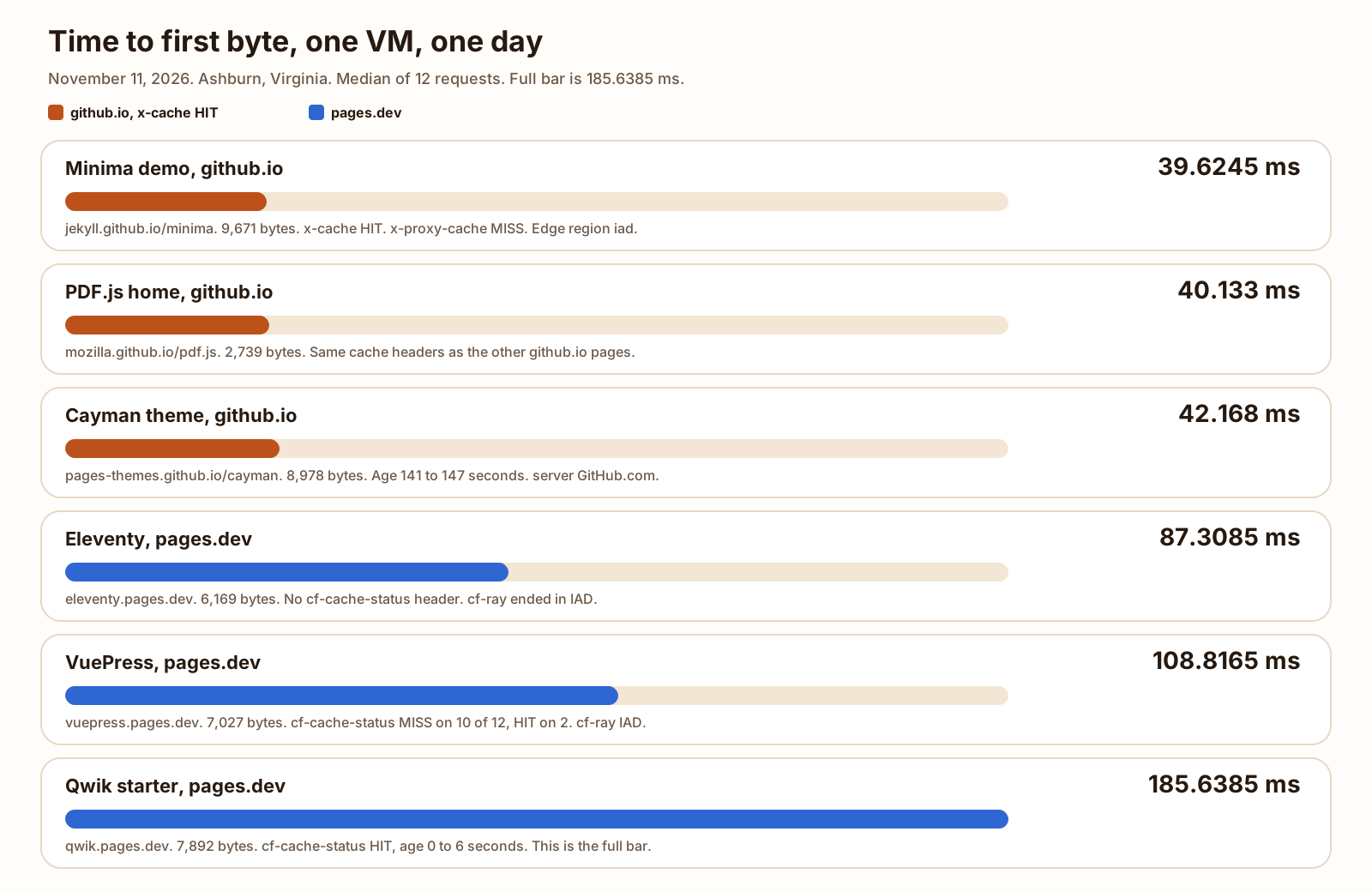
The limits above are the docs. The only clock in this post is a fetch of six public homepages that were already deployed. Three are on github.io: the Cayman theme, the Minima demo, and the PDF.js home page. Three are on pages.dev: vuepress.pages.dev, qwik.pages.dev, and eleventy.pages.dev. Cayman and Minima are GitHub’s and Jekyll’s own theme demos. PDF.js is that project’s homepage. The three pages.dev sites are public projects that answered on those hostnames. They are not one template deployed twice, and they are not Cloudflare’s own docs.
What we tested
Checked
What was tested: six public homepages, from this VM, on November 11, 2026. One warmup request per URL, not in the table. Then 12 measured requests, interleaved in the order Cayman, Minima, PDF.js, VuePress, Qwik, Eleventy, one new curl process each time so the connection was not reused. curl 8.5.0. Every measured response was HTTP 200 and HTTP/2. The User-Agent was shipmunks-ttfb/1.0. curl was not passed --compressed, so these are the uncompressed HTML sizes.
The command, with the timing fields this post uses:
curl -sS --max-time 25 -A shipmunks-ttfb/1.0 -o /dev/null -D headers.txt -w '%{time_namelookup} %{time_connect} %{time_appconnect} %{time_starttransfer} %{time_total} %{http_code} %{size_download} %{http_version}\n' URLTTFB is time_starttransfer. Total is time_total. Both include DNS, TCP, and TLS. For 12 samples, the median is the mean of the 6th and 7th sorted values. The first measured request started at 2026-11-11T16:10:24.797Z and the last finished at 2026-11-11T16:10:31.569Z.
ipinfo.io, checked at the start of the run, reported one VM in Ashburn, Virginia, Amazon AS14618. Every github.io response had x-github-edge-region: iad. Every pages.dev cf-ray ended in IAD.
What was not tested: a build duration on either host. The timeouts in the table are the documented caps, not a stopwatch. A move from GitHub Pages to Cloudflare Pages. Nothing was deployed, and no repository was connected. One site placed on both hosts. A Function, a redirect rule, or a custom header on a project I control. Private-repository publishing. Any city other than this VM in Ashburn, on this day. This is one machine, one day, and not a benchmark of every region.
| Page | Host | Bytes | Median TTFB | Min | Max | Median total | Cache on the 12 |
|---|---|---|---|---|---|---|---|
| Minima demo | github.io | 9,671 | 39.6245 | 30.056 | 54.037 | 39.6765 | x-cache HIT. x-proxy-cache MISS. No cf-cache-status. Age 141 to 147 seconds. cache-control max-age=600. server GitHub.com. |
| PDF.js home | github.io | 2,739 | 40.133 | 28.115 | 105.790 | 40.186 | Same github.io cache headers as Minima. x-cache HIT on all 12. x-proxy-cache MISS on all 12. |
| Cayman theme | github.io | 8,978 | 42.168 | 30.221 | 96.454 | 42.362 | Same github.io cache headers. Age 141 to 147 seconds. |
| Eleventy | pages.dev | 6,169 | 87.3085 | 78.034 | 119.560 | 87.3745 | server cloudflare. cf-ray ended IAD. No cf-cache-status and no x-cache. cache-control public, max-age=0, must-revalidate. |
| VuePress | pages.dev | 7,027 | 108.8165 | 87.872 | 153.753 | 108.8765 | cf-cache-status MISS on 10, HIT on samples 8 and 11. No x-cache. cf-ray IAD. cache-control public, max-age=0, must-revalidate. |
| Qwik starter | pages.dev | 7,892 | 185.6385 | 70.413 | 407.754 | 186.194 | cf-cache-status HIT on all 12. Age 0 to 6 seconds. cache-control max-age=60. No x-cache. cf-ray IAD. The first sample’s last-modified was Wed, 11 Nov 2026 16:10:24 GMT. |
The two middle Cayman TTFB samples are 41.366 ms and 42.970 ms, and the mean is 42.168 ms. Minima is 39.322 and 39.927, mean 39.6245. PDF.js is 39.885 and 40.381, mean 40.133. Eleventy is 86.954 and 87.663, mean 87.3085. VuePress is 106.622 and 111.011, mean 108.8165. Qwik is 176.766 and 194.511, mean 185.6385.
Every measured total was within 1 ms of that sample’s TTFB. The largest gap was 0.828 ms, on Qwik sample 2. The bodies are a few kilobytes. On this run the lowest median was the Minima demo and the highest was the Qwik starter. These six medians do not choose the host. The choice is the limits in the short answer. The pages are different sizes, and the cache state is not the same: the github.io responses were x-cache: HIT while x-proxy-cache was MISS, VuePress was a miss on 10 of 12, Qwik was a hit with an age under 7 seconds, and Eleventy sent neither cache header.
| Sample | Cayman | Minima | PDF.js | VuePress | Qwik | Eleventy |
|---|---|---|---|---|---|---|
| 1 | 33.877 | 51.232 | 29.856 | 119.021 | 322.433 | 113.932 |
| 2 | 32.016 | 39.322 | 39.767 | 138.227 | 194.511 | 87.663 |
| 3 | 96.454 | 30.233 | 41.215 | 97.749 | 99.087 | 79.575 |
| 4 | 50.070 | 42.528 | 40.819 | 87.872 | 219.436 | 78.034 |
| 5 | 44.035 | 44.637 | 45.169 | 134.081 | 241.826 | 80.402 |
| 6 | 44.103 | 30.056 | 38.123 | 111.011 | 360.016 | 82.716 |
| 7 | 49.365 | 31.275 | 39.885 | 103.003 | 407.754 | 99.976 |
| 8 | 42.970 | 31.735 | 41.083 | 100.749 | 107.628 | 86.954 |
| 9 | 39.712 | 49.812 | 40.381 | 106.622 | 176.766 | 80.472 |
| 10 | 41.366 | 30.844 | 105.790 | 120.358 | 76.815 | 119.560 |
| 11 | 30.221 | 39.927 | 28.115 | 92.874 | 70.413 | 105.667 |
| 12 | 32.542 | 54.037 | 31.813 | 153.753 | 86.823 | 102.046 |
Which to pick
If you are choosing Cloudflare Pages or GitHub Pages, use the row you actually need.
- You need a custom header, a path redirect, or server-side code: Cloudflare Pages. Those three are documented on Cloudflare Pages and are not in the GitHub Pages docs read today.
- The site is a public repository of HTML, CSS, and JavaScript, and the URL you want is github.io: GitHub Pages. GitHub Free includes that.
- The site is an online business, a store, or commercial software as a service: leave GitHub Pages. The limits page says that use is not allowed. The free-cap comparison for a small site on Vercel or Netlify is Vercel vs Netlify.
- The repository is private and the account is GitHub Free: GitHub Pages from that repository does not stay published. Cloudflare’s limits page allows a private repository on the Pages side and does not name a paid Pages plan for it.
- You are about to open a new project on Cloudflare: the Pages index says to start on Workers. Read Cloudflare Workers vs Pages before you create a Pages project.
- The thing you are hosting is a process that stays on, with Postgres: that bill is Vercel vs Railway, not this pair. Heroku, Render, Fly.io, and a small VPS for one web process are in Heroku alternatives.
- The domain answers and you want Google to fetch it: how to get a new website indexed.
FAQ
Is GitHub Pages free for private repos?
No. GitHub’s plans page says GitHub Free includes GitHub Pages in public repositories, and the pricing page shows Free at $0 USD. The custom domains page says a site published from a private repository is unpublished if you downgrade from GitHub Pro to GitHub Free. When a plan does allow a private repository, the publishing-source page says the site is still public on the internet. Publishing the site so that only people with read access can open it requires an organization on GitHub Enterprise Cloud. The pricing page read November 11, 2026 shows Team at $4 USD per user a month and Enterprise at $21 USD per user a month, and it does not print a GitHub Pro price.
Can I move from GitHub Pages to Cloudflare Pages?
The documented path is to connect that GitHub repository with Cloudflare’s GitHub integration, which builds on each push, and then add the custom domain on the Pages project. GitHub’s publishing-source page is how the github.io site is set. The limits in this post are the caps on each side of that move.
Is Cloudflare Pages being replaced by Workers?
The Pages index, last updated August 25, 2026, says to start new projects on Workers, and it does not say Pages is deprecated. Pages still documents Git, direct upload, and the Free plan limit of 500 deploys a month. The feature split is Cloudflare Workers vs Pages.
Sources
- Limits (Cloudflare Pages) Checked
- Pricing (Cloudflare Pages Functions) Checked
- Functions (Cloudflare Pages) Checked
- Redirects (Cloudflare Pages) Checked
- Headers (Cloudflare Pages) Checked
- Custom domains (Cloudflare Pages) Checked
- Serving Pages (Cloudflare Pages) Checked
- Build configuration (Cloudflare Pages) Checked
- Framework guides (Cloudflare Pages) Checked
- Cloudflare Pages (product index) Checked
- GitHub integration (Cloudflare Pages) Checked
- GitHub Pages limits Checked
- What is GitHub Pages? Checked
- About custom domains and GitHub Pages Checked
- Securing your GitHub Pages site with HTTPS Checked
- GitHub's plans Checked
- Changing the visibility of your GitHub Pages site (GitHub Enterprise Cloud) Checked
- About GitHub Pages and Jekyll Checked
- Configuring a publishing source for your GitHub Pages site Checked
- Using custom workflows with GitHub Pages Checked
- Dependency versions (GitHub Pages) Checked
- GitHub pricing Checked